A guard clause is a check at the start of a function that exits early when a condition is not met. It returns, throws or skips before the main logic runs. The result: no pyramid of nested if blocks, and the normal path of the function reads from top to bottom.
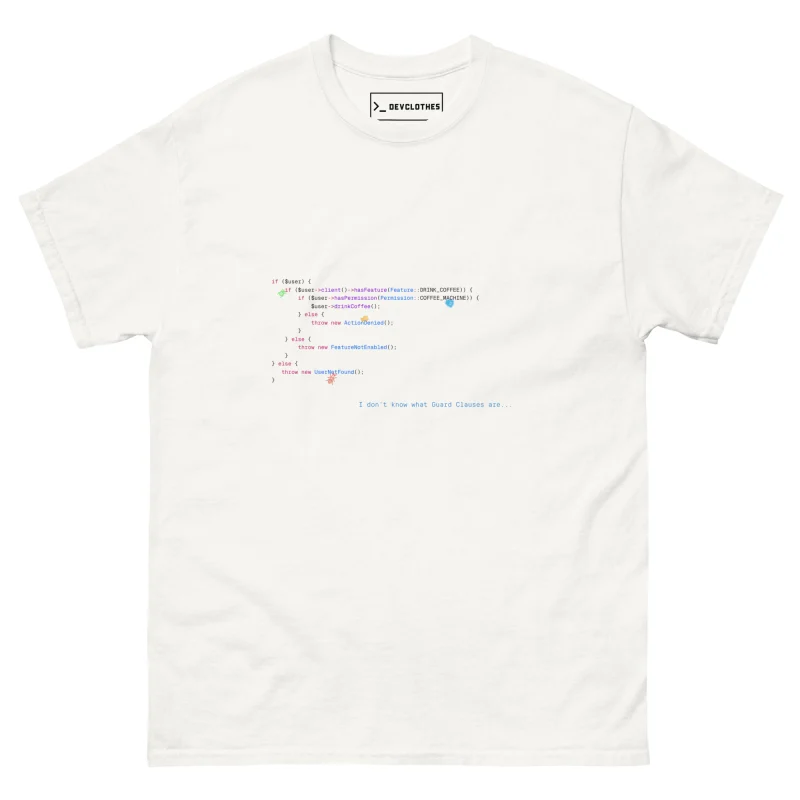
Our Guard Clauses shirt shows the opposite on purpose: a staircase of nested conditions, the kind of code that guard clauses exist to remove. That is the joke. The rest of this page explains the pattern so you can laugh at the shirt with a clear conscience.
Before and after: the same function, flattened
Here is a function that ships an order. Every check wraps the next one, so the real work sits four levels deep and each error message lives far away from the condition that triggers it:
def ship_order(order):
    if order is not None:
        if order.is_paid:
            if order.items:
                if order.address:
                    return create_shipment(order)
                else:
                    raise ValueError("Missing address")
            else:
                raise ValueError("Order is empty")
        else:
            raise ValueError("Order not paid")
    else:
        raise ValueError("No order")
Now the same behaviour with guard clauses. Each invalid case leaves the function at once, and the last line is the happy path:
def ship_order(order):
    if order is None:
        raise ValueError("No order")
    if not order.is_paid:
        raise ValueError("Order not paid")
    if not order.items:
        raise ValueError("Order is empty")
    if not order.address:
        raise ValueError("Missing address")
    return create_shipment(order)
Both versions raise the same error for the same input and call create_shipment in the same case. Only the shape changes. To get there, you invert each condition (is not None becomes is None) and move its error branch up next to it.
Where the name comes from
Martin Fowler lists the move as a named refactoring, Replace Nested Conditional with Guard Clauses, in his online refactoring catalog. His example computes a pay amount and collapses an if/else tree into one line per special case:
function getPayAmount() {
  if (isDead) return deadAmount();
  if (isSeparated) return separatedAmount();
  if (isRetired) return retiredAmount();
  return normalPayAmount();
}
Wikipedia’s article on guards credits Kent Beck with naming the practice as a design pattern, and notes that the technique itself is much older. The broader idea of a guard, a Boolean condition that must be true before a branch runs, also appears in formal methods and in functional languages such as Haskell.
The nested shape has its own nickname: arrow code, because the indentation forms an arrowhead pointing right. Jeff Atwood’s 2006 post Flattening Arrow Code puts “replace conditions with guard clauses” first on his list of fixes.
Why developers find the shirt funny
Every developer has met the staircase. Usually in a file nobody wants to touch, written years ago, with the important line hidden at indentation level six. Sometimes the author was you.
The shirt wears that code proudly, under a title that promises the cure. It is the same kind of joke as a “Clean Code” sticker on a 3,000-line class. People who do code reviews get it at once, and some of them will start refactoring your chest in their head.
When to use guard clauses, and when not to
| Use a guard clause for | Keep a normal if/else for |
|---|---|
| Invalid input: null, empty, wrong type | Two equally normal outcomes, such as a discount or no discount |
| Permissions: the user cannot do this | Business rules where both branches carry real logic |
| Nothing to do: empty list, already processed | Cases where the reader needs to see both options side by side |
A guard clause says “this case is not interesting, leave now”. If both branches matter equally, an if/else states that more honestly. Fowler draws the same line in his book Refactoring.
Inside loops, the guard is continue:
for user in users:
    if not user.is_active:
        continue
    send_newsletter(user)
Some style guides used to require a single return per function, a rule inherited from structured programming. With guard clauses you accept several exits in exchange for flat code. Most modern linters agree with that trade, and some flag deep nesting directly: Pylint, for example, has a too-many-nested-blocks check.
Get the shirt
The Guard Clauses tee prints the anti-pattern so you do not have to commit it. It pairs well with the Demeter shirt, another design rule people break every day, explained in the Law of Demeter. If the nested code worked anyway and you cannot say why, see the “it works, why?” meme.
Guard Clauses T-Shirt · 24 €
The pyramid of doom, printed so nobody has to merge it.

Demeter's Law T-Shirt · 24 €
Another rule every code reviewer quotes.

It Works, Why? Developer T-Shirt · 24 €
For the nested code that works anyway.
All shirts are unisex, S to 5XL, printed on demand. Check the size guide before ordering. More in our developer t-shirts and the Christmas gift guide for programmers.
FAQ
What is a guard clause in simple terms?
A check at the top of a function that leaves early when something is wrong or there is nothing to do. The rest of the function can then assume the input is valid.
Is a guard clause the same as an early return?
Almost. An early return is the mechanism. A guard clause is the pattern of using it at the start of a function to handle invalid or trivial cases. A guard can also throw an exception or use continue in a loop.
Do guard clauses work in every language?
Yes, in any language with return or exceptions. Swift even has a dedicated guard statement, whose else branch must exit the current scope.