
Being on-call means you are the person who answers when production breaks. If an alert fires at 3 am, your phone rings, and you must start working on it within minutes.
Our shirt is a commit card with three lines: Written by: nobody, Reviewed by: nobody, and, in red, On-call: me. An AI agent wrote it, nobody checked it, and a human still carries the pager.
What on-call means
The Google SRE book chapter “Being On-Call” gives a clear definition: “When on-call, an engineer is available to perform operations on production systems within minutes.” The engineer “is expected to triage the problem and work toward its resolution”.
Google also limits the load, because a tired engineer makes bad decisions:
- No more than 25% of an SRE’s time is spent on-call.
- Purely operational work is capped at 50%.
- “The maximum number of incidents per day is 2 per 12-hour on-call shift.”
“You build it, you run it”
The idea that developers carry the pager for their own code comes from Amazon. In a 2006 ACM Queue interview, quoted on the AWS News Blog, Werner Vogels said: “You build it, you run it.” The same quote warns that “your manager may very well hand you a pager that same day”.
The rule works because the person who wrote the code knows it best. With AI agents, that link is broken. The code has an author that does not answer the phone.
The pager in the AI era
In May 2026, Redowan Delowar wrote “If you won’t carry the pager, maybe don’t push to mainline”. His point: “operating it means carrying the pager”, and “unless you carry the pager, maybe your code shouldn’t go to mainline.”
The data supports the worry. The 2024 DORA report found that as AI adoption increased, it was accompanied by “an estimated reduction in delivery stability by 7.2%.” The 2025 report repeats that “AI adoption does continue to have a negative relationship with software delivery stability,” and sums it up: “AI doesn’t fix a team; it amplifies what’s already there.” Both are correlations, not proof of cause, but less stability means more pages.
How to make the 3 am page less likely
| Commit card | Better version |
|---|---|
| Written by: nobody | Written by an agent, owned by a named person |
| Reviewed by: nobody | Reviewed by someone who could debug it |
| On-call: me | On-call: the owner, with a runbook |
- Every change has a human owner, even if an agent wrote it.
- Small changes, so the person on-call can find the cause fast.
- Feature flags and fast rollback, so the fix at 3 am is one command.
For the review step that went missing, see LGTM. For the factory with no humans at all, see the dark software factory.
Get the shirt
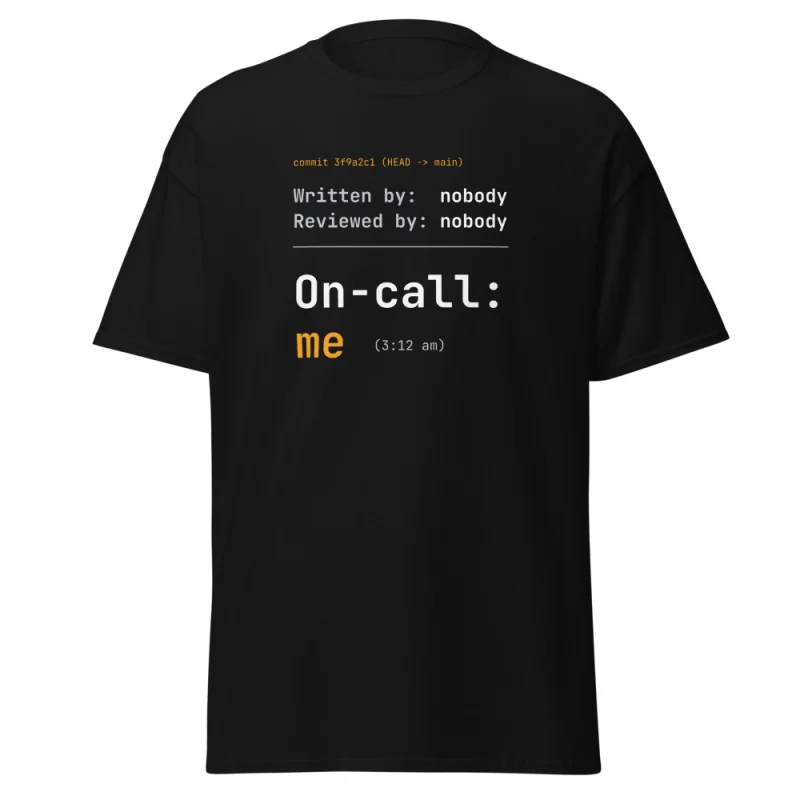
On-Call Me T-Shirt · 24 €
Written by nobody. On-call: me.
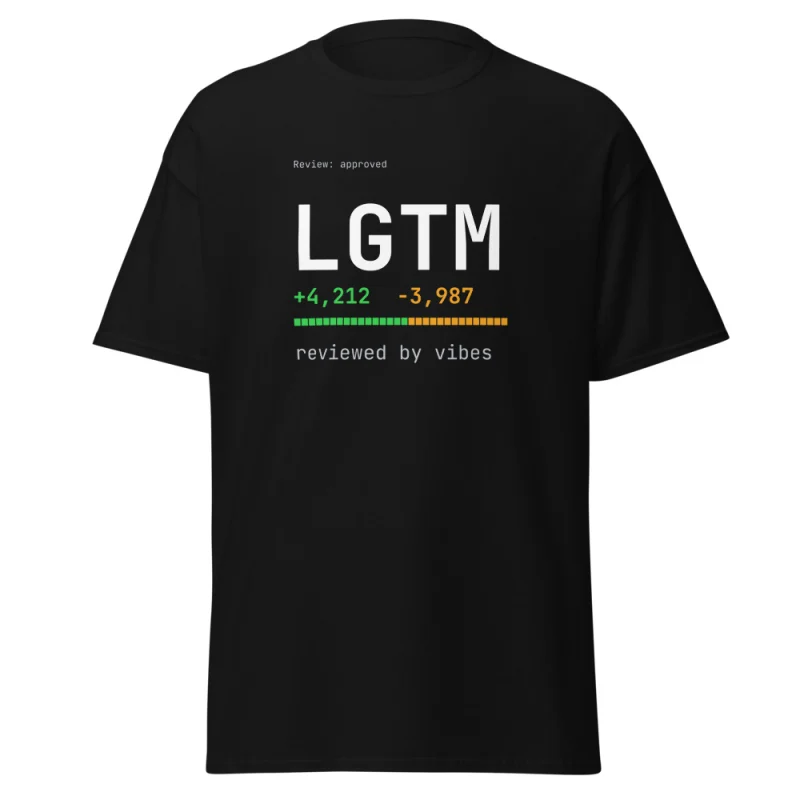
LGTM T-Shirt · 24 €
How it got merged.
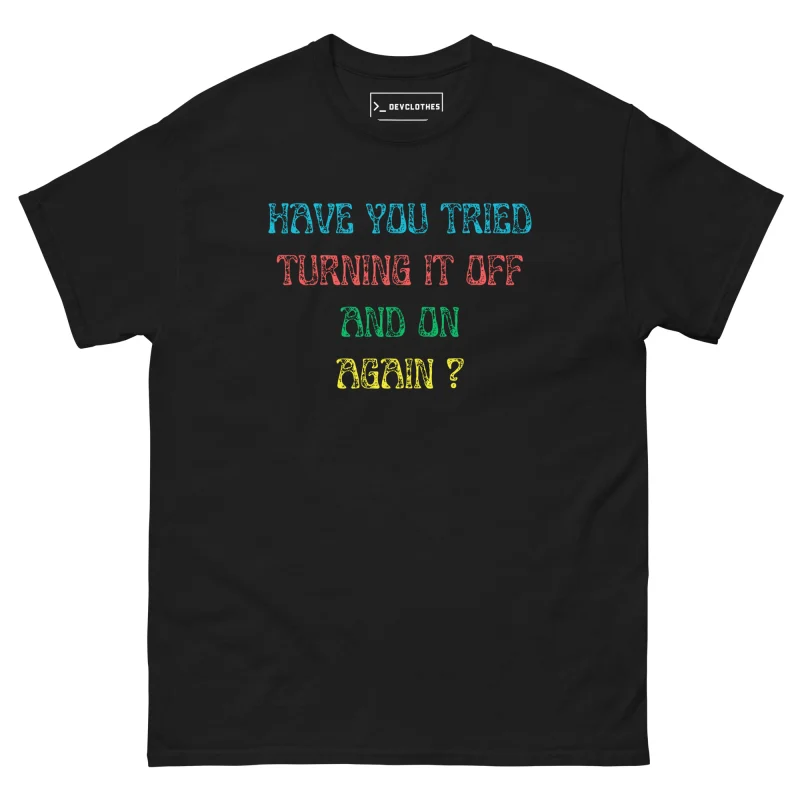
Have You Tried Turning It Off and On Again T-Shirt · 24 €
Step one at 3 am.
All shirts are unisex, S to 5XL, printed on demand in black, graphite heather and white. Check the size guide before ordering. More ideas in the Christmas gift guide for programmers.
FAQ
What does on-call mean in software?
You are responsible for answering production alerts during a shift, usually within minutes, at any time of day.
Who said “you build it, you run it”?
Werner Vogels, Amazon’s CTO, in a 2006 interview with ACM Queue.
How much on-call is too much?
The Google SRE book caps on-call at 25% of an engineer’s time and aims for at most 2 incidents per 12-hour shift.