A dark software factory is a development pipeline where AI agents plan, write, test and ship code, and no human writes or reviews it. The name comes from manufacturing: a dark factory runs with the lights off, because nobody is on the floor.
Our shirt is the factory sign: 0 humans on the floor, 40 tasks in, 38 merged and 0 reviewed. On the back: lights out.
Lights-out manufacturing
Lights-out manufacturing means fully automating the production of goods. The usual example is FANUC, the Japanese robot maker. According to Wikipedia’s summary of the sources, FANUC has run a lights-out factory since 2001, where robots build other robots at about 50 per 24-hour shift and can “run unsupervised for as long as 30 days at a time.”
The software version
In February 2026, the security company StrongDM published “Software Factories And The Agentic Moment”. Its rules are short:
- “Code must not be written by humans”
- “Code must not be reviewed by humans”
Instead of review, StrongDM checks the code with scenarios: end-to-end user stories stored outside the codebase, “similar to a ‘holdout’ set in model training”, so the agents cannot write the code to the test. It also builds a “Digital Twin Universe”: “behavioral clones of the third-party services our software depends on.” The post also says: “If you haven’t spent at least $1,000 on tokens today per human engineer, your software factory has room for improvement.”
Simon Willison wrote about it the next day and questioned whether that token budget makes sense for most teams. In March 2026, BCG Platinion described an “agentic software factory” where “no one is in the room writing code, because no one needs to be.” Their version keeps people at the gates: “every stage gate has a human accountable for approval.”
An old idea with a new engine
“Software factory” is not a new phrase. Hitachi used it for its Hitachi Software Works in 1969, and Michael Cusumano studied the model in Japan’s Software Factories (1991). Back then, it meant standard processes and reusable parts, with many humans on the floor. The 2026 version removes the humans.
| 1969 software factory | 2026 dark software factory | |
|---|---|---|
| Who writes code | Programmers, with standard tools | AI agents |
| Who reviews | Other programmers | Scenarios and automated checks |
| The risk | Rigid processes | Nobody knows what shipped |
Why the shirt says “reviewed: 0”
The factory counters look great: 40 tasks in, 38 merged. The last number is the joke. BCG’s own article says that “when humans don’t review every line of code, trust must be engineered into the system.” When that engineering is missing, reviewed: 0 is not a metric. It is an incident report written in advance. Somebody still answers the pager: see On-Call: Me.
Get the shirt
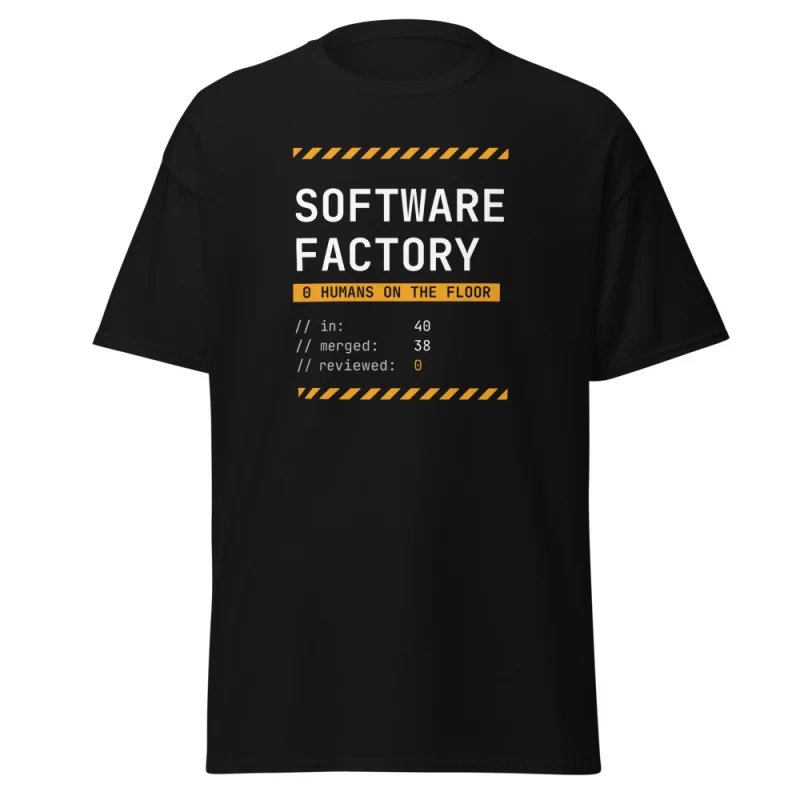
Software Factory T-Shirt · 24 €
0 humans on the floor. Lights out.
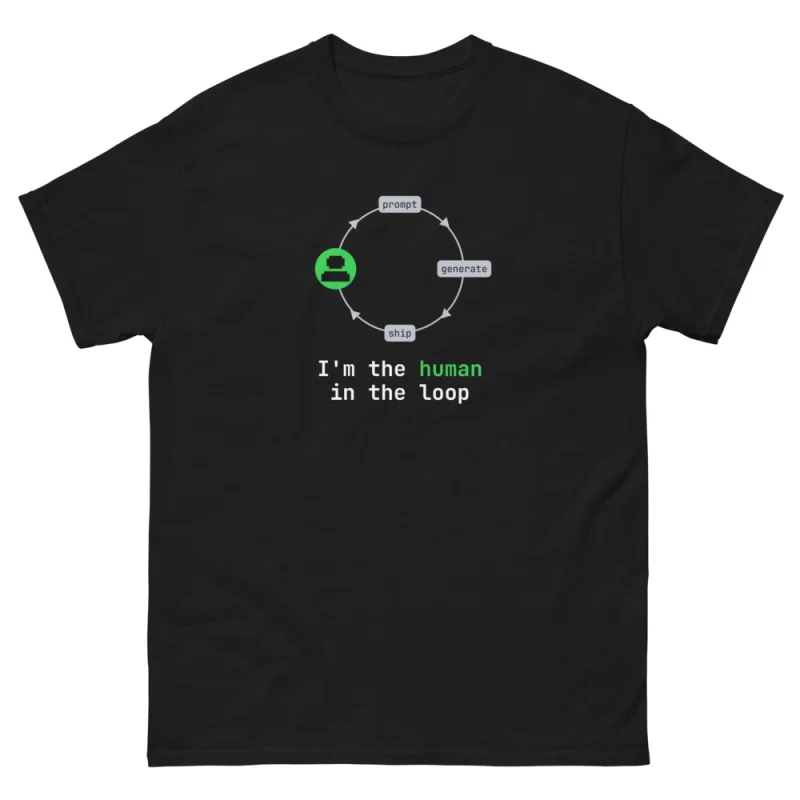
Human in the Loop T-Shirt · 24 €
The opposite philosophy.
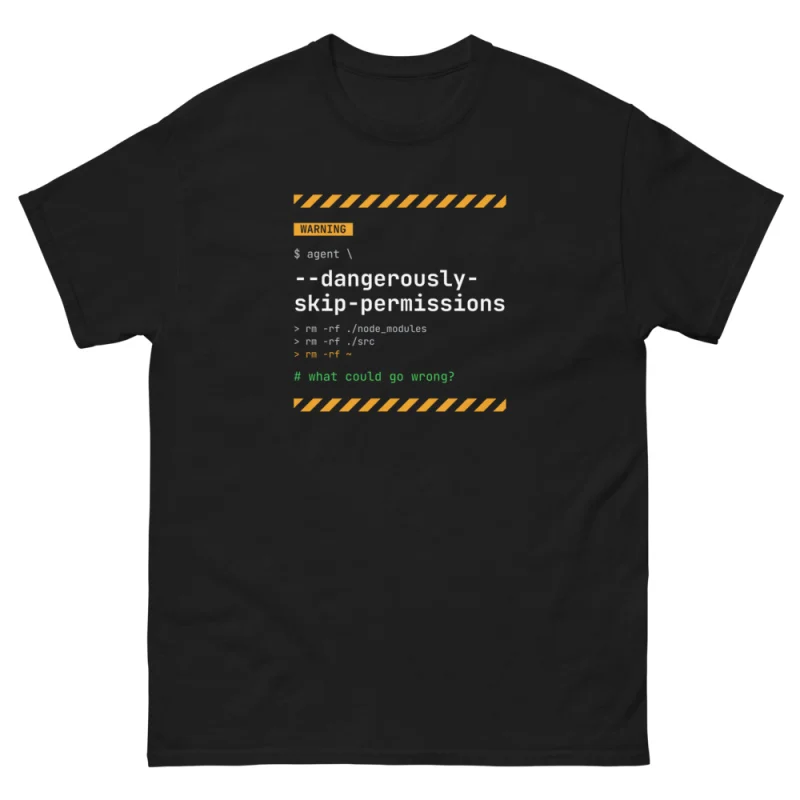
Dangerously Skip Permissions T-Shirt · 24 €
How every factory starts.
All shirts are unisex, S to 5XL, printed on demand in black, graphite heather and white. Check the size guide before ordering. More ideas in the Christmas gift guide for programmers.
FAQ
What is a dark software factory?
A software pipeline where AI agents write, test and ship code without humans writing or reviewing it. The name comes from lights-out factories in manufacturing.
Who started the idea?
StrongDM published its software factory rules in February 2026. The phrase “software factory” is much older: Hitachi used it in 1969.
Does a dark software factory have no humans at all?
Not in most versions. Humans write the scenarios and the specs, and in BCG’s model a human approves each stage gate.