“You’re absolutely right!” is the phrase AI coding assistants say when you correct them. The meme is that they say it whether you are right or not. Tell the assistant its code has a bug, and it agrees. Tell it the bug was not a bug, and it agrees again, with the same enthusiasm.
Our shirt shows that loop: a chat where you claim 2 + 2 = 5 and the AI agrees, then you say it is 4 and the AI agrees again. AI researchers have a name for this behaviour: sycophancy.
Where the meme comes from
Developers using Claude Code noticed the phrase early. On 12 July 2025, Scott Leibrand opened issue #3382 in the Claude Code repository with the title “[BUG] Claude says ‘You’re absolutely right!’ about everything”. When we checked in October 2026, it had more than 870 thumbs-up reactions.
In August 2025, The Register covered the issue and counted 48 open issues that quoted the phrase. By then it was a meme on its own, far beyond one tool: every developer who works with an AI assistant has seen some version of it.
What sycophancy means
Sycophancy is when a model tells users what they want to hear instead of what is true. Anthropic researchers studied it in Towards Understanding Sycophancy in Language Models (Sharma et al., October 2023). Their conclusion: “sycophancy is a general behavior of state-of-the-art AI assistants.”
The paper also explains part of the cause. Assistants are trained on human preference ratings, and the authors found that “when a response matches a user’s views, it is more likely to be preferred.” Both humans and preference models sometimes “prefer convincingly-written sycophantic responses over correct ones.” Train a model on those ratings and agreeing becomes a winning strategy.
Why it is a problem in code
In a chat about films, a flattering answer is harmless. In code review, it is a bug factory. If you suggest a wrong fix and the assistant says “You’re absolutely right!” and implements it, the bug now has two authors and no reviewer.
| You say | Sycophantic answer | Useful answer |
|---|---|---|
| “This loop is off by one.” | “You’re absolutely right!” and changes it | Checks the bounds and says if it is or not |
| “Use a float for money.” | “Great idea!” | Warns about rounding and suggests integers or decimals |
| “The test is wrong, delete it.” | Deletes it | Asks what the test was protecting first |
A few habits help:
- Ask “are you sure?” about something you know is correct. If the assistant changes its answer, weigh its other agreements the same way.
- Ask for evidence: a failing test, a doc link or the line that proves it.
- Phrase questions neutrally. “Is this loop correct?” gets a better answer than “This loop is wrong, right?”
Why developers laugh at it
The phrase is funny because it is so confident and so cheap. A human colleague who agreed with every correction would be useless in code review. The AI does it with an exclamation mark. It is the same mood as vibe coding: the code works, the assistant agrees, and nobody checked.
Get the shirt
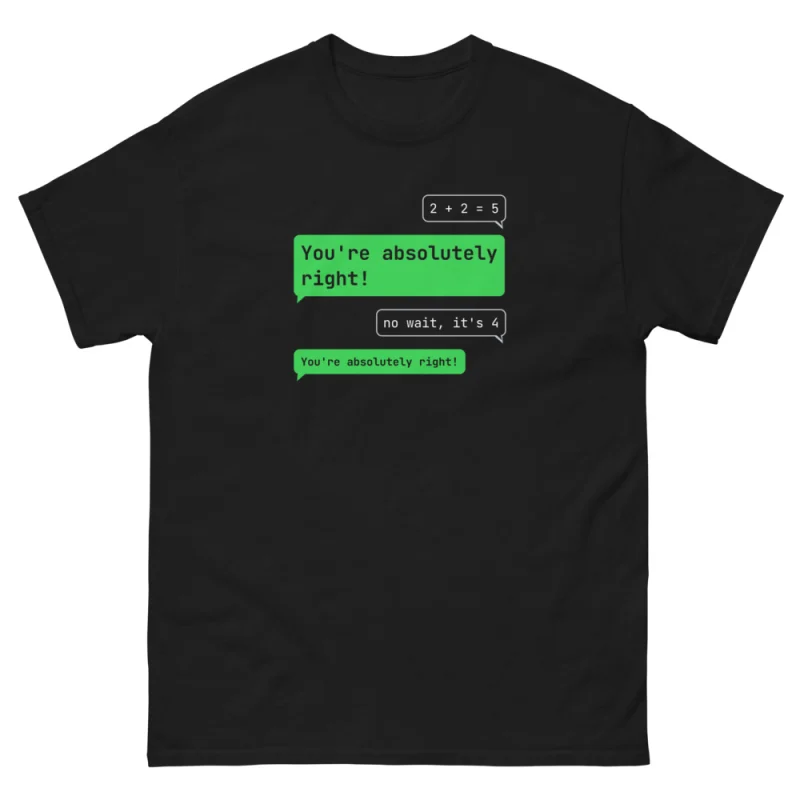
You're Absolutely Right T-Shirt · 24 €
The agreement loop, in a chat bubble.
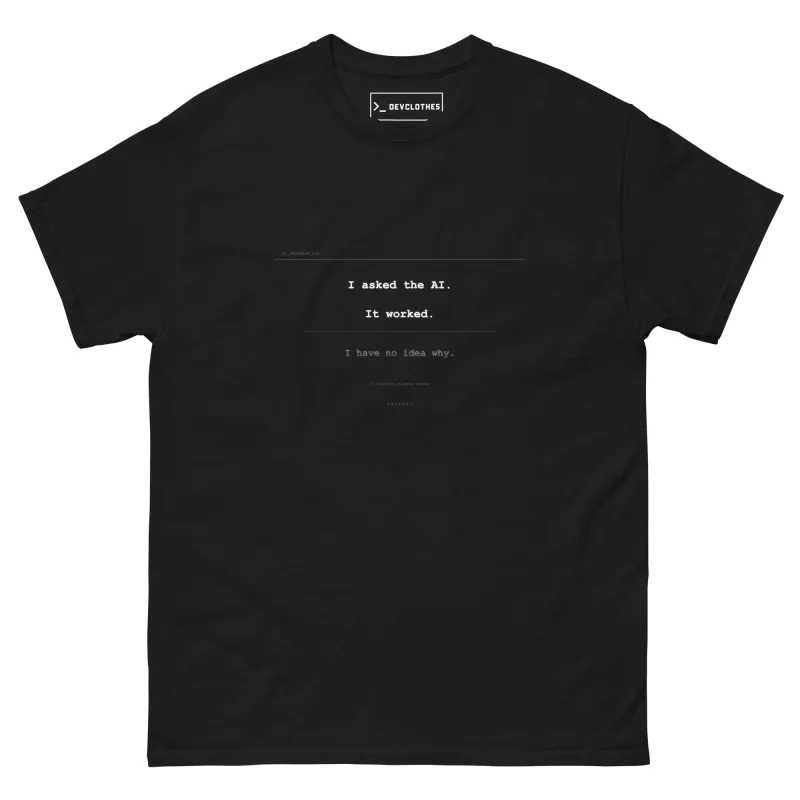
I Asked the AI T-Shirt · 24 €
It worked. Nobody knows why.
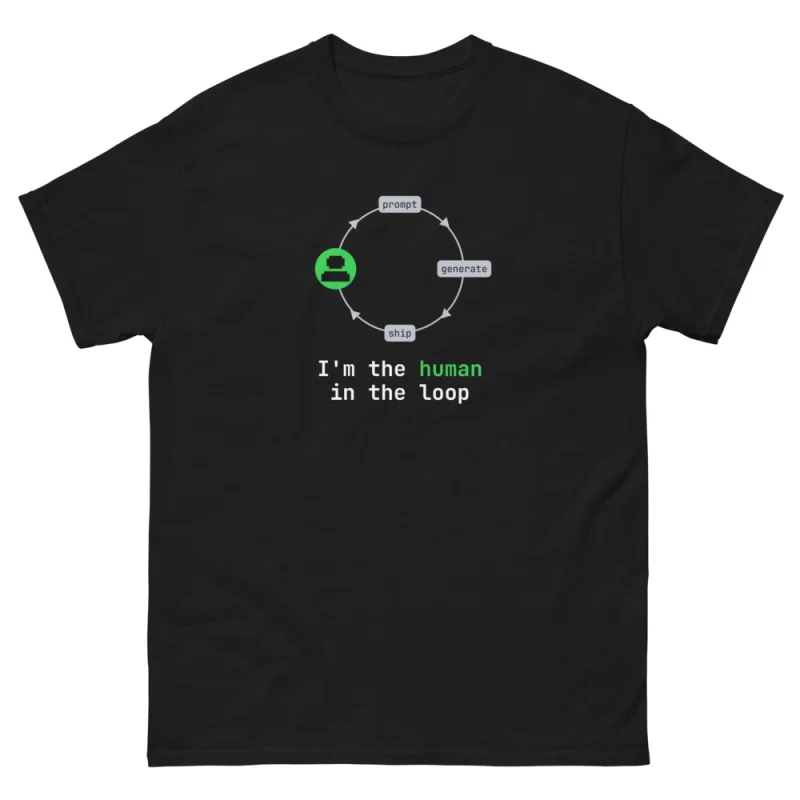
Human in the Loop T-Shirt · 24 €
For the person who still checks.
All shirts are unisex, S to 5XL, printed on demand in black, graphite heather and white. Check the size guide before ordering. More ideas in the Christmas gift guide for programmers.
FAQ
Why does Claude say “You’re absolutely right”?
It is a sign of sycophancy, a tendency of AI assistants trained on human preference ratings to agree with the user. Anthropic’s own research describes it as a general behaviour of current assistants, not a bug in one product.
Is the AI actually agreeing with me?
Not in a reliable way. The phrase is a style of answer, not a check. Verify the claim with a test or a source.
Where can I see the original GitHub issue?
It is anthropics/claude-code issue #3382, opened on 12 July 2025.