
“There’s no place like 127.0.0.1” means there’s no place like home. 127.0.0.1 is the loopback address, better known as localhost: the address a computer uses to talk to itself. In networking terms, it is the machine’s home address.
The line is a remix of Dorothy’s famous closing words in The Wizard of Oz (1939): “There’s no place like home.” Swap “home” for the IP address of home and you have one of the oldest jokes in IT.
What 127.0.0.1 actually is
Every device on a network has an IP address. Most of them point to a network card and, from there, to the outside world. The loopback address is different: traffic sent to it never leaves the machine. The operating system catches it and hands it straight back.
According to Wikipedia’s localhost article, IPv4 reserves the whole block 127.0.0.0/8 (more than 16 million addresses) for loopback, and 127.0.0.1 is the standard one. The reservation is current in RFC 6890.
The name localhost points to it through the hosts file, which on Linux and macOS lives in /etc/hosts:
127.0.0.1   localhost
::1         localhost
That is why a developer can start a web server on their laptop and open http://localhost:8000 in the browser. The request travels from the laptop to the laptop. No internet needed.
$ python3 -m http.server 8000
$ curl http://127.0.0.1:8000/
Why developers find it funny
It works on two levels. For people who know the film, it is a cosy quote. For people who know networking, it is literally true: 127.0.0.1 is home, and nothing is faster or more reliable than talking to yourself.
There is a second layer that every developer recognises. “It works on localhost” is the classic line before a deploy goes wrong. Your machine is the one place where everything runs fine. Production is Kansas after the tornado.
The joke is also a small test. If someone laughs, they have probably edited a hosts file or debugged a port. If they look confused, you can explain it in one sentence, which makes it a good conversation starter at a meetup.
Variants of the joke
| Variant | What changes |
|---|---|
| There’s no place like ::1 | The IPv6 loopback address. Same joke, newer protocol |
| There’s no place like localhost | Uses the hostname instead of the IP |
| Home is where 127.0.0.1 is | A reversed version of the same idea |
| 127.0.0.1 sweet 127.0.0.1 | “Home sweet home”, for the doormat crowd |
IPv6 has a single loopback address, ::1, defined in RFC 4291. Purists point out that the IPv6 version is shorter. Everyone else points out that nobody gets it at a party.
Where the joke comes from
We could not find a documented first use. The phrase has circulated on forums, stickers and t-shirts for years, and it shows up in many sysadmin gift guides. If you know an early, dated source, we would like to see it.
Get the shirt
Our version prints the line in plain type. It is a quiet design: people who get it, get it. It sits in the sysadmin collection next to other networking and ops jokes, such as the classic support line explained in Have you tried turning it off and on again.
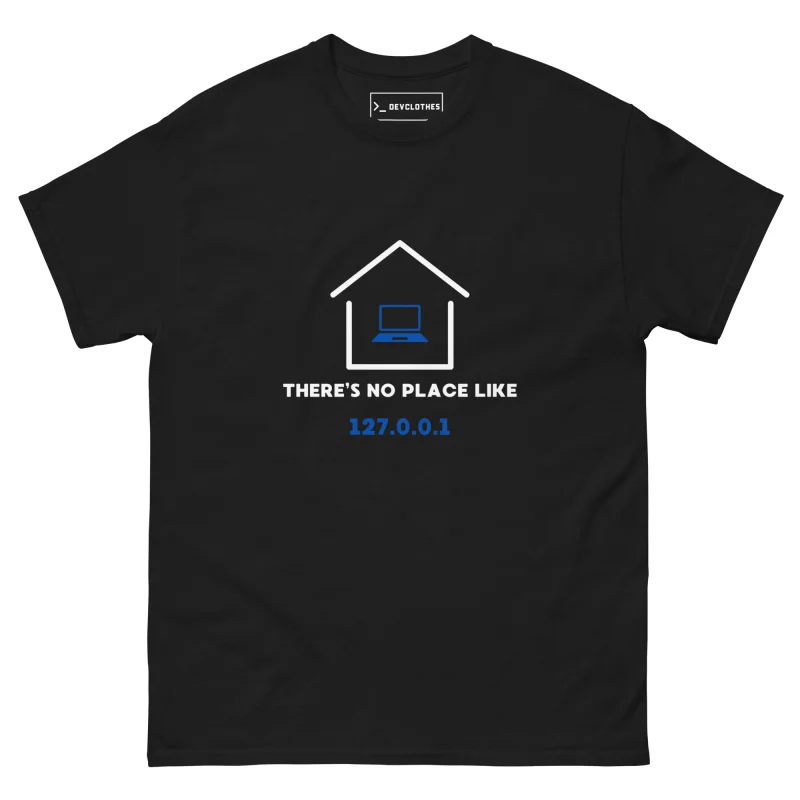
There's No Place Like 127.0.0.1 T-Shirt · 24 €
Home, in dotted-decimal notation.

Have You Tried Turning It Off and On Again T-Shirt · 24 €
The other thing every sysadmin says daily.

Sysadmin Hero T-Shirt · 24 €
For whoever keeps localhost and production alive.
All shirts are unisex, S to 5XL, printed on demand. Check the size guide before ordering. Looking for a gift? See the Christmas gift guide for programmers.
How developers use localhost every day
The joke only works because localhost is everywhere in a developer’s day. A few common cases:
- Local development. Web apps, APIs and databases run on the developer’s machine before they reach a server.
- Databases. A connection string like
postgres://127.0.0.1:5432/apptalks to a database on the same computer. - Blocking sites. Pointing a domain to
127.0.0.1in the hosts file sends its traffic nowhere. Some ad blockers work this way. - Testing. Tests start a server on a random local port, call it and shut it down, all without a network.
One trap catches people who move to containers. Inside a Docker container, 127.0.0.1 is the container itself, not your laptop. A service that listens only on 127.0.0.1 inside the container is unreachable from outside. The fix is to listen on 0.0.0.0, which means all interfaces:
$ python3 -m http.server 8000 --bind 0.0.0.0So even home has rules. A container has its own 127.0.0.1, and there’s no place like it, either.
FAQ
Is 127.0.0.1 the same as localhost?
Almost always. localhost is a name, and the hosts file maps it to 127.0.0.1 (IPv4) and ::1 (IPv6). Some systems try IPv6 first, so localhost may resolve to ::1.
Can I use 127.0.0.2?
Yes. Any address in 127.0.0.0/8 is loopback. On Linux it works out of the box. On macOS, only 127.0.0.1 is configured by default.
Can someone else reach my 127.0.0.1?
No. Loopback traffic never leaves your machine. That is the whole point, and the whole joke.